
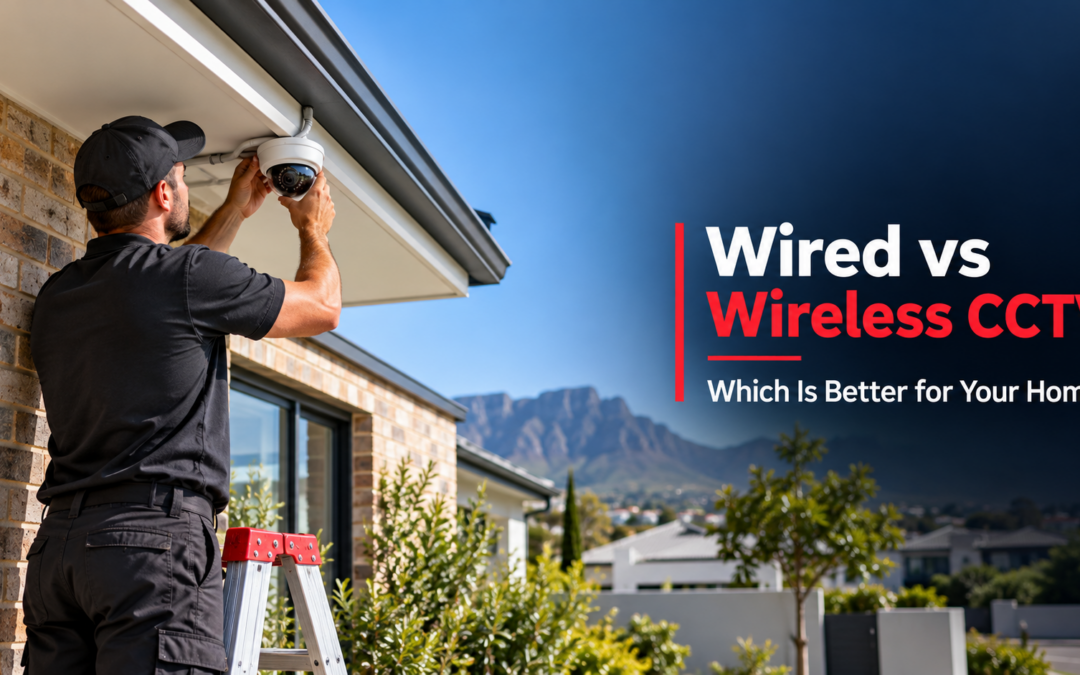
For most Cape Town homes, a wired CCTV system is the more reliable choice. Cameras connected by cable to a recorder (usually with PoE, where one cable carries both power and video) don’t depend on Wi-Fi, are harder to knock offline and keep recording through load shedding when the recorder and network sit on a UPS or battery backup. Wireless cameras are quicker to install and work well where running cable is difficult, but they need a strong Wi-Fi signal and a power source at every camera.
The right answer depends on your property, how much you want to spend on installation and how you want to view and store footage. Here’s how the two options compare.
What is the difference between wired and wireless CCTV?
The difference is how each camera sends video and gets power.
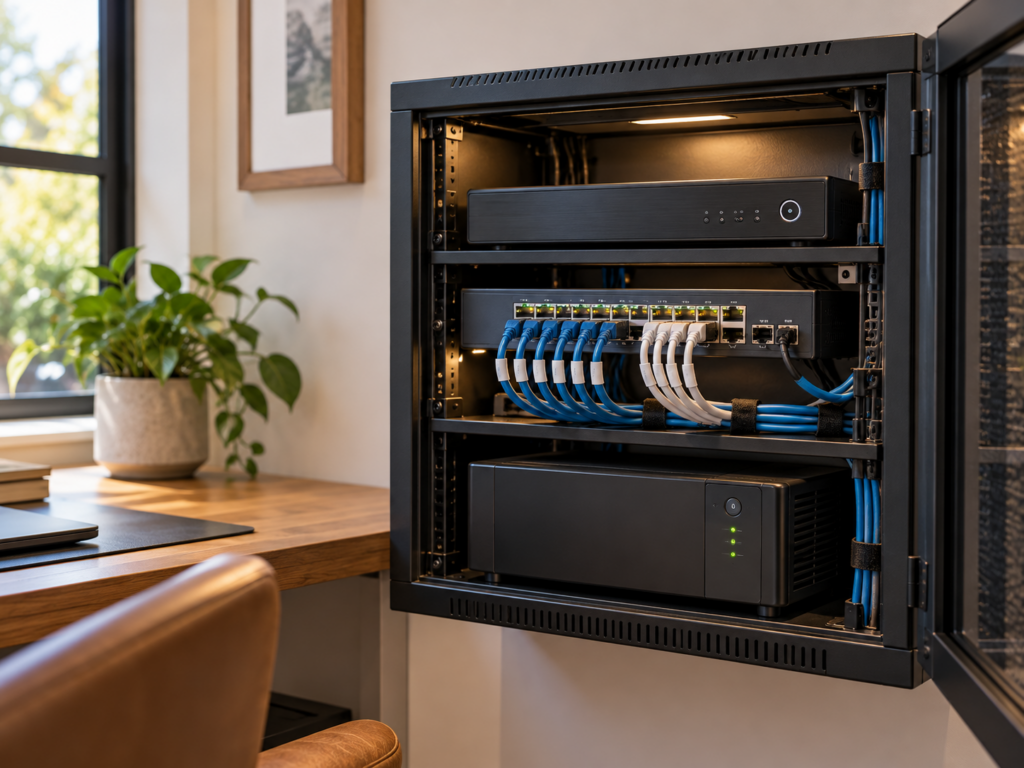
- Wired (PoE or analogue/HD) cameras run a cable from each camera back to a recorder (an NVR or DVR) inside the house. With PoE (Power over Ethernet) IP cameras, one network cable carries power and data, so there’s no need for a plug point at each camera.
- Wireless (Wi-Fi) cameras send video over your Wi-Fi network to a recorder, an app or the cloud. Most still need a power cable or a plug point nearby. Truly wire-free cameras run on batteries or a small solar panel.
So “wireless” usually means no video cable, not no cables at all. That surprises a lot of homeowners.
Which is more reliable, wired or wireless CCTV?
Wired systems are generally more reliable. A cable doesn’t suffer from weak signal, interference from neighbours’ networks or a router that drops out. That matters for security cameras, because footage is only useful if it was actually recorded at the moment something happened.
Wireless cameras can work very well, but performance depends on:
- Distance from the router and how many walls are in the way.
- Interference from other Wi-Fi networks, which is common in complexes and dense suburbs.
- Your router, which becomes a single point of failure for the whole system.
- Upload speed, if footage is sent to the cloud.
On larger properties in areas like Durbanville or Brackenfell, cameras on boundary walls and gates are often too far from the house for a dependable Wi-Fi signal without adding extra access points.
What happens to CCTV during load shedding?
This is where wired systems usually win in South Africa. With a PoE setup, the recorder and the PoE switch power every camera. Put those on a UPS or connect them to your inverter, and the whole system keeps running when the power goes off.
Wireless cameras each need their own power source. If they plug into the mains, every camera needs backup power, and your router does too. Battery-powered cameras keep working, but they typically record motion clips rather than continuously, and batteries need regular recharging.
If load shedding returns over summer, ask your installer exactly how long the system will run on backup and what’s covered: cameras, recorder and router.
Is wireless CCTV easier to install?
Yes. Wireless cameras need little or no cabling, so installation is faster and causes less disruption. That makes them useful for:
- Rented homes, where you can’t chase cables into walls.
- Hard-to-reach spots, such as a detached garage or a far corner of the garden.
- Adding one or two cameras to an existing system.
Wired installs take longer because cables have to be routed neatly through roofs, walls or conduit. Done properly, though, that work is a once-off and the system should run for years with little attention.
Which gives better picture quality?
Both can deliver sharp, high-resolution footage. The real difference is consistency. A wired camera sends a steady stream to the recorder, while a wireless camera may lower its quality or drop frames when the signal weakens. For number plates at the gate or faces at the front door, steady quality makes a real difference.
Whichever type you choose, camera placement, lighting and night vision matter as much as the resolution printed on the box.
Can you view wired CCTV on your phone?
Yes. A common misconception is that only wireless systems offer app viewing. A wired system with a networked recorder lets you view live and recorded footage on your phone from anywhere, receive alerts and share clips. The cameras are wired; your remote access still runs over the internet.

Is a hybrid system the best of both?
Often, yes. Many homes end up with a wired system for the main points (gate, driveway, front door, perimeter) and one or two wireless cameras where cabling isn’t practical. CCTV also works best as part of a layered system with an alarm and outdoor beams, so cameras record and alerts go off when something triggers.
Which should you choose?
- Choose wired if you own your home, want the most reliable recording, need cameras far from the house or want the system to keep running during load shedding.
- Choose wireless if you rent, need a quick install, only want one or two cameras, or have spots where cabling isn’t possible.
- Choose a hybrid if you want a reliable core system with flexibility for awkward areas.
For complexes, estates and businesses, wired IP systems are almost always the standard because of the number of cameras and the need for continuous recording. See our commercial security options for more.